WINNERGY MEDICAL PUBLIC COMPANY LIMITEDSET: WINMED🇹🇭 TH

CG Policy · 2025

Corporate Governance Policy

Has a Corporate Governance Policy

Yes

Policy Description

The Board of Directors recognizes the importance of adhering to the Principles of Good Corporate Governance and has established policies to continuously promote and enhance good corporate governance practices within the organization. The Board believes that good corporate governance is a crucial factor in ensuring the effective operation of the Company, as well as in enhancing value and maximizing long-term returns for shareholders and all stakeholders.

Good corporate governance is regarded as a key mechanism that reflects an effective management system characterized by transparency, fairness, and accountability. These practices contribute to building confidence among shareholders, investors, and all stakeholders, thereby supporting long-term growth and sustainable value creation for the company.

Since the transformation of the business into a public limited company, the Company’s board of directors has developed policies for good corporate governance and ethical conduct in the Company’s operations, which align with laws and regulations, SEC CG Code, SET CG Principles, and IOD’s criteria. The policies are reviewed annually.

Policy & Practices — Board of Directors

Has Policy & Guidelines for the Board

Yes

Board Guidelines

GuidelineDetail
Nomination of Directors

The selection and remuneration committee is responsible for the selection and appointment of suitable candidates for board and C-level positions through a process of screening based on criteria, policies, methods, and predetermined selection procedures. The committee presents its recommendations to the Company's board of directors and/or shareholders' meeting for approval as appropriate.

Additionally, the Board of Directors is governed by a transparent and clear selection and appointment process that ensures the appointment of qualified board members in accordance with the established criteria.

In selecting and appointing new board members, the selection and remuneration committee considers qualifications in terms of experience, knowledge, and abilities that will benefit the company and align with the Company's business strategy. Furthermore, the committee may engage professional search firms or director pools to help with the selection process.

When considering the reappointment of existing board members, the selection and remuneration committee evaluates various factors such as knowledge, abilities, experience, expertise, and specific skills that align with the company's business strategy, including the board member's performance, attendance, and participation in board meetings, as well as their support of board activities.

The appointment of directors shall comply with the Company's regulations, legal requirements, and other relevant provisions. It must be transparent and clear.

However, the rights of retail investors in appointing directors are outlined in the Company's regulations, which specify that shareholders have the authority to appoint directors through the shareholders' meeting. The details are summarized as follows:

  1. One shareholder has one vote equal to one share. one vote

  2. In the election of board members, the voting method may involve casting votes for individuals one by one or for a group of people as a single team, according to the total number of board members to be elected at that time. This depends on what the shareholders' meeting deems appropriate. However, in each vote, each shareholder must cast all the votes they have. It is possible to elect a single individual or a group of people as a team for the board, but the distribution of votes for each individual or team cannot be partial.

  3. The person who receives the highest number of votes in descending order will be elected as a board member for the same number of members that are required or to be elected in that round. In the event that individuals who receive the same number of votes are higher than the number of board members required or to be elected in that round, the chairman of the meeting shall cast the deciding vote.

Determination of Director Remuneration

The Company has clearly set a framework and the director’s remuneration policy at an appropriate level to the duties and responsibilities, and in accordance with the remuneration of companies in the same industry and of similar size. Improvement will be made when changes occur. The remuneration must be suitable and sufficient to motivate and retain qualified directors. Nomination and Remuneration Committee membership will annually consider and propose the director’s remuneration to the board of directors’ meeting and the shareholders’ meeting to consider and approve.

Policy on Directors' Remuneration

The Company specifies that the remuneration of the board of directors and its subcommittees must be appropriate, taking into consideration the remuneration of companies in the same industry and those of similar size. Additionally, the remuneration should be suitable for the duties, responsibilities, and performance of the directors in order to motivate and retain high-quality personnel.

The Company does not have a policy of providing remuneration in any other form of currency besides meeting allowances.

However, executives, advisors, employees, or representatives of major shareholders are not entitled to receive remuneration as board members or subcommittee members.

Nonetheless, directors who are employees or staff of the company are entitled to allowances and benefits that are provided to employees or staff of the Company, according to the Company's regulations. The remuneration received by directors as board members will not affect their rights to receive the aforementioned allowances and benefits as employees or staff of the Company.

Independence of the Board of Directors from the Management

The Company clearly delineates the roles, duties, and responsibilities between the Board of Directors and the management. the Board of Directors is responsible for oversight and for making strategic decisions and decisions on matters that are material to the Company’s business operations, to ensure compliance with applicable laws, the Company’s objectives, Articles of Association, shareholders’ resolutions, and good corporate governance policies. The management, on the other hand, is responsible for implementing the approved strategies and policies, as well as managing the Company’s day-to-day operations.

The Company places importance on maintaining the independence of the Board of Directors from the management by prescribing clear qualifications for independent directors, who must be free from vested interests or conflicts of interest. Independent directors are provided with accurate, complete, and transparent information to enable them to effectively perform their oversight, review, and decision-making duties in a fair and efficient manner. This helps enhance transparency and build confidence among shareholders and all stakeholders.

Director Development

When appointing a new director to the Company's board, the Company will prepare important information regarding its business operations, corporate governance policies, and business ethics, as well as information relevant to the director's role. This includes meetings with the management or executives of the Company to provide additional information and to familiarize the new director with the duties and responsibilities. Furthermore, the Company also values training programs for board members, which are organized by the Thai Institute of Directors and other institutions.

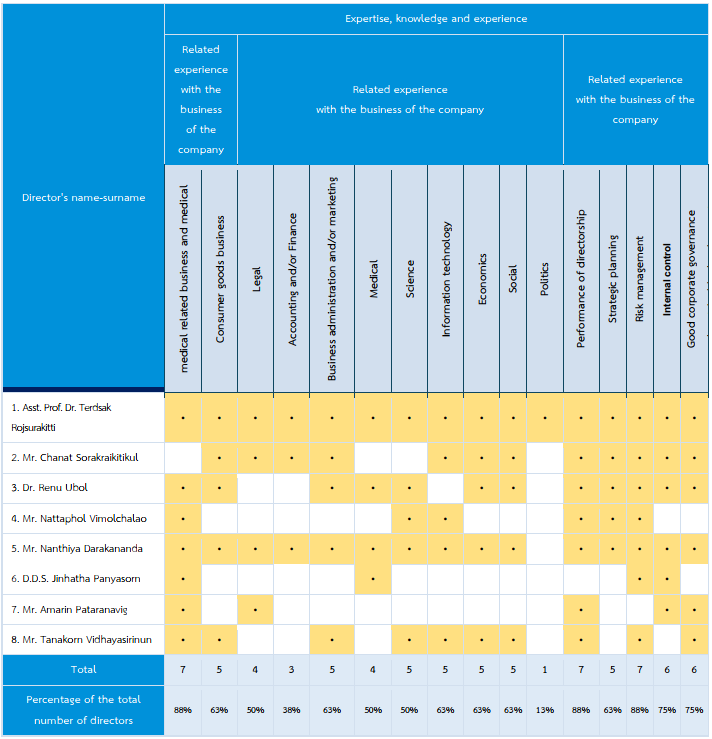
Board Skill Matrix

The board of directors possesses the appropriate qualifications that align with the Company's business strategy, as well as a diverse range of knowledge, abilities, skills, experience, and expertise that are beneficial to the company's operations, as follows:

Board Performance Evaluation

Performance Evaluation of the Board of Directors and Subcommittees

The Company will conduct an annual performance evaluation of the board of directors and subcommittees. The evaluation will be divided into two categories according to the evaluation form of the Thai Institute of Directors (IOD), as follows:

  1. Self-evaluation form for the Board of Directors and Subcommittees, by Committee.

  2. Self-evaluation form for the Board of Directors and Subcommittees, by Individual.

Process for Evaluating the Performance of the Board of Directors and Subcommittees

  1. The Nomination and Remuneration Committee will consider and establish policies and criteria for evaluating each main topic in the evaluation form.

  2. The Corporate Secretary will distribute the evaluation forms for the Board of Directors and subcommittees to assess their annual performance, both by committee and by individual.

  3. All directors will return the evaluation forms to the Corporate Secretary for collection and summary of results. The report will be presented to the Nomination and Remuneration Committee and the Board of Directors at the first meeting of the following year.

Corporate Governance of Subsidiaries and Associated Companies

The mechanism for supervising and overseeing the management and operational responsibility of subsidiary and joint venture companies approved by the board of directors. The Board of Directors sets the mechanism for supervising and overseeing the operations of subsidiary and joint venture companies to preserve the benefits of the Company's investment, as follows:

  1. The Company will send "representatives" who possess qualifications and experience suitable for the businesses and operations of the companies they invest in. To become a director in such companies, they must be considered and approved at a board of directors meeting.

  2. The "representatives" of the company may hold positions such as chairman, CEO, board member, senior executive, or any person in the company who does not conflict with the business interests of these companies. This is to allow the company to oversee and manage the operations of each company as if they were their own unit, as well as to ensure that all operations comply with laws, regulations, and policies of the companies.

  3. Sending "representatives" to become directors in the companies they invest in will be based on the proportion of shareholding in each company and/or mutual agreement in the case of joint ventures, which determines the number of directors to control and oversee.

  4. The Company will establish plans and take necessary actions to ensure that each company they invest in has sufficient disclosure of information and internal control systems suitable for their business operations.

  5. The Company will closely monitor the performance and operations of each company they invest in, including data collection and accounting record keeping, to allow for easy verification.

  6. The Company monitors the disclosure of information regarding its financial position and operational performance, transactions of subsidiaries, related-party transactions, as well as the acquisition or disposal of significant assets. The Company ensures that all material information is disclosed to the Company accurately, completely, and in a timely manner.

Policy & Practices — Shareholders and Stakeholders

Introduction

The Company is aware and emphasizes the importance of granting basic rights to every shareholder of the Company in a fair and equal manner, in order to build confidence and trust among shareholders and investors. As a part of the company’s corporate governance policy, the basic rights of shareholders are stipulated in writing, including the right to attend shareholders’ meetings, the right to express opinions, the right to communicate with one another without hindrance or obstruction from the company, the right to participate in making important decisions of the company such as the allocation of profits, the appointment or removal of directors, the consideration of director compensation, the appointment of auditors, the approval of significant transactions affecting the company’s business direction, as well as the right to receive sufficient, accurate and timely information.

Rights of Shareholders

1. Facilitating the shareholders in the shareholders' meeting

The Company's mission is to promote convenience for all shareholders, including major shareholders, minor shareholders, institutional investors, and foreign shareholders, by granting them full rights through shareholder meetings, so that they can participate in important decision-making concerning the Company's operations or matters that affect their interests in various aspects. Therefore, the Company has policies to facilitate and promote shareholder participation in company shareholder meetings. The Company schedules appropriate dates and times for meetings, avoiding holidays and non-working days that are within three days of each other, and schedules meetings during regular business hours between 8:30 a.m. and 4:00 p.m. Sufficient time is allocated for the meeting, and shareholders are given the right to participate in the meeting electronically. In the past year, the Board of Directors unanimously approved to hold the shareholders' meeting in the form of “electronic meetings” only. The Company also provides video viewing of the shareholder meeting for shareholders and the public who cannot attend the meeting. The video can be viewed on the Company’s website.

The Company provides a service to close stamp duties in the power of attorney book given to the assignee who attends the meeting, without charge, in order to reduce the cost burden of providing stamp duties for shareholders.

The Company has established procedures regarding documents showing the identity of shareholders in cases where they delegate their proxy to other persons to attend meetings. Copies of various documents can be used, such as a copy of ID card, a copy of government officer ID card, a copy of driver’s license, a copy of passport, a copy of certificate of registration of the shareholder’s legal entity, and other documents, without the need for original documents. The Company does not require foreign shareholders to provide certified documents prepared by relevant authorities in foreign countries, such as the notary public, to avoid complications or limitations on the right of shareholders to attend meetings.

2. Procedures before the shareholders’ meeting

The Company has a policy of granting shareholders the right to propose agenda items and nominate individuals with suitable qualifications to be elected as directors of the Company at the annual shareholders' meeting. Additionally, the Company provides an opportunity for shareholders to submit questions regarding the Company or the meeting agenda in advance of the annual shareholders’ meeting. Details of the criteria for granting these rights are published on the Company’s website under the Investor Relations > Shareholders Meeting section (https://www.winmed.com/th/investor-relations/downloads/shareholders-meeting?year=2025), and are also disclosed through the website of the Stock Exchange of Thailand to ensure that shareholders are as informed:

  • Rights of Shareholders to Propose AGM Agenda and Nominate Qualified Persons to be Elected as Directors of the Company: November 8, 2024, to February 28, 2025.

  • Giving the right to submit questions in advance meeting: November 8, 2024, to February 28, 2025.

The scheduled date for the 2025 Annual General Meeting (AGM) is April 24, 2025. As of February 28, 2025, no shareholders have proposed any agenda items or nominated individuals for election as directors

The scheduled date for the 2025 Annual General Meeting (AGM) is April 24, 2025. As of February 28, 2025, no shareholders have proposed any agenda items or nominated individuals for election as directors. Furthermore, the Company has promptly notified the Stock Exchange of Thailand of the meeting schedule after the Board of Directors’ meeting, or no later than 9:00 a.m. on the next working day, to enable shareholders and investors to quickly become aware of the meeting schedule and agenda.

The Company has a policy to disclose invitations to shareholder meetings, along with meeting materials in both Thai and English, on the Company’s website under Investor Relations > Shareholders Meeting (https://www.winmed.com/th/investor-relations/downloads/shareholders-meeting?year=2025) at least 28 days prior to the meeting. The Company also sends out invitations to shareholders by mail, in both Thai and English, at least 21 days prior to the meeting to notify shareholders in advance and provide them with sufficient information to prepare for the meeting. The invitations specify the date, time, format, location, agenda, and clear and adequate reasons for each agenda item in order to facilitate informed decision-making by shareholders. In addition, the company published a notice in a daily newspaper at least 3 days prior to the meeting.

The Company has a policy that allows shareholders, including subsidiary shareholders and institutional investors, to register in advance to attend the shareholder meeting. This is seen as a way to facilitate convenience for all shareholders and prevent delays on the day of the meeting. The Company also has a policy to protect the rights of shareholders who are unable to attend the meeting in person, by providing the opportunity for shareholders to appoint someone else or the independent directors of the Company to attend the meeting on their behalf. The Company has specified that the number of independent directors of the Company shall not be less than 2, and the details and necessary evidence that shareholders and their appointed representatives must present to register to attend the meeting are specified in the proxy letter sent along with the invitation letter to the meeting.

For the annual shareholder meetings in 2024 and 2025, the Company held the meetings via electronic media, using the services of a service provider with a meeting system that complies with the laws regarding electronic meetings. The company also sent a user manual for the electronic meeting system along with the invitation letter to the meeting shareholders.

3. Procedures on the day of the shareholders’ meeting

The Company clarifies the process of attending meetings, asking questions, voting, and vote counting in order for all shareholders to clearly know in advance through various channels, e.g., publishing on the Company website. This includes before the start of the meeting; the company has played a video demonstrating the use of the electronic conferencing system for shareholders to acknowledge.

Before the shareholders’ meeting starts, the meeting chairperson will introduce the Board of Directors, executives, accountants, and legal advisors, as well as the person in charge of verifying the accuracy of the vote count at the meeting and representatives from the Thai Investors Association and the Stock Exchange of Thailand (if any), to inform the shareholders.

Additionally, the Company has a policy to allow two shareholders (if any) who attend the meeting to serve as witnesses to verify the vote count together with the legal advisor. Furthermore, the Company will notify the proportion of shareholders attending the meeting, including those who attend the meeting in person and by proxy, as well as explain the procedures and methods for casting votes. Moreover, at the end of each agenda of the meeting, the chairman will provide an opportunity for the shareholders to ask questions and express opinions appropriately and sufficiently. The Board of Directors and executives will answer questions related to the Company’s operations and the shareholders’ meeting agenda to inform the shareholders and record the questions and answers in the Company’s meeting report.

During the annual shareholders’ meetings for the year 2025, the board of directors and CEO attended the meetings at the Company’s headquarters, which was the venue for the meetings and live broadcasts (depending on the case). The attendance rate was 100% with the following details:

The Company was honored by the participation of legal advisors, auditors, and representatives from various organizations in the meeting as follows:

  • Legal Consultant, including Mr. Prathomphon Fangkamdee from Pro Legal & IP Co., Ltd.

  • Accountants including Mr. Athipong Athiphongsakul, Mr. Hongyok Wimonchat, and Miss Anusara Chadsunthorn from ANS Audit Co., Ltd., participated in the meeting via electronic media.

  • Representatives from various organizations attended the meeting via electronic media, including representatives from the Thai Investors Association.

Additionally, for voting, vote counting, and the method of vote tallying for each agenda item, technology was used to ensure speed, accuracy, and convenience for shareholders during the meeting. The results of the vote count were immediately displayed for shareholders' awareness. Voting was organized to separate the agenda items clearly, such as separating the vote on the election of directors from the vote on determining directors' remuneration. In the agenda regarding the election of directors, the company provided shareholders with the opportunity to vote for each director individually.

The Company has a policy for conducting shareholder meetings in accordance with the agenda notified in the invitation letter, without adding important information during the meeting or adding other agenda items not specified in advance or changing the order of agenda items or important information without prior notice to shareholders. This is to ensure that shareholders are informed in advance about the issues to be considered in order to make informed decisions about attending the meeting.

The Company has a policy of providing equal opportunities for all shareholders to express their opinions, make suggestions, or ask questions related to various meeting agendas freely and appropriately before making any resolutions. The board of directors and executives of the Company are responsible for responding to questions and clarifying facts at the meetings. The Company will record in the meeting a report in which shareholders asked questions or expressed opinions and how the company responded to them. This information will be disclosed on the Company’s website. (https://www.winmed.com/th/investor-relations/downloads/shareholders-meeting?year=2025)

Regarding the determination of remuneration for the Board of Directors, such as fixed remuneration, meeting fees, and other benefits (if any), the Company has clear policies, methods, and criteria that are comparable to the same industry. This includes considering the performance of the Board of Directors and subcommittees and profit growth, which must be approved by the nomination and remuneration committee and the board of directors before being proposed for approval at the shareholders' meeting.

4. Actions after the shareholders’ meeting

To ensure that shareholders are informed and able to verify information regarding the Company’s shareholder meetings in a timely manner, the Company will publish the minutes of the shareholder meetings along with the voting results after the close of the meetings, or no later than 9:00 a.m. on the following business day, through the website of the Stock Exchange of Thailand. The Company has a policy to disclose the shareholder meeting reports in both Thai and English, which will be published simultaneously on the Company’s website within 14 days from the date of the meeting, and will not engage in any transactions or trading of assets that violate or do not comply with the rules of the Stock Exchange of Thailand or any relevant agencies.

The Company will record and prepare accurate and complete reports of shareholder meetings in both Thai and English languages. The reports will include important information such as meeting format, proportion of shareholders attending, criteria and methods for voting and vote counting, use of voting cards for each agenda item, names and positions of board members, highest executives, auditors and legal advisors who act as representatives of shareholders and witnesses to the vote counting at the meeting, and representatives from investor associations promoting Thai investments. The content of the meeting agenda, important issues and questions, proposals, comments, and resolutions with voting results will also be included. Shareholders can vote by electronic means. The reports of shareholder meetings will be published on the Company’s website (https://www.winmed.com/th/investor-relations/downloads/shareholders-meeting?year=2025) to provide shareholders, both Thai and foreign, with fast and equal access to information and the ability to verify the accuracy of information. Shareholders can also express their opinions or raise any questions or concerns regarding the reports by contacting the Company’s secretary without waiting for the next meeting. The Company will submit the reports to relevant authorities within the time frame required by law.

5. Violations and non-compliance with the rules

In 2025, the Company was not fined, sanctioned, or civilly prosecuted regarding the equitable treatment of shareholders. There were no obstructions to shareholder communication, and the Company did not withhold any information that would have a significant impact on the Company or its shareholders.

Equitable Treatment of Shareholders

The Company recognizes the importance of equitable treatment for all shareholders. Consequently, the Board of Directors has established policies to protect the rights of every shareholder group, including major, minor, institutional, and foreign shareholders, ensuring they can exercise their rights equally. Furthermore, the Company is committed to managing shareholder interests with propriety, fairness, and transparency to protect them from potential abuses of power by controlling parties. To this end, the Company has implemented the following measures:


1.Types of shares and voting rights

There is only one type of company’s shares according to the company’s articles of association, namely ordinary shares with the name of the shareholder. Every shareholder has the right to vote in proportion to his or her shareholding: one share equals one vote.


2. Company shareholding structure

The company has a policy of disclosing the shareholding structure of the top 10 highest shareholding proportions of the company, including major shareholders, shareholders with controlling power, and institutional investors, as well as the proportion of free float, while maintaining the proportion of minority shareholders in compliance with the criteria set by the Stock Exchange of Thailand. This includes having a proportion of minority shareholders of more than 25 percent.

As of the record date for the list of shareholders eligible to attend the Annual General Meeting of Shareholders for the year 2025 on March 13, 2025, the Company had a proportion of minority shareholders of 29.29 percent. The company has also disclosed its shareholding structure in the annual report for the year 2025 (Form 56-1 One Report) on the Company’s website (https://www.winmed.com/th/investor-relations/downloads/one-report) and on the website of the Stock Exchange of Thailand. In addition, the Company has a transparent and auditable operational structure and does not have complex or difficult-to-identify shareholding structures, cross holdings, or pyramid holdings.


3. Notice of shareholders’ meeting

The Company places equal importance on treating each shareholder equally, regardless of whether they are major shareholders, minority shareholders, or foreign shareholders. Shareholders will receive advance notice of the agenda for the annual shareholders’ meeting, and even though the majority of the Company’s shareholders may be Thai, the Company has prepared invitations and related documents in both Thai and English for the convenience of both Thai and foreign shareholders. In addition, the Company has posted notifications on the website of the Stock Exchange of Thailand to inform shareholders that the invitations and related documents for the meeting are available for download in both Thai and English formats on the company’s website (https://www.winmed.com/th/investor-relations/downloads/shareholders-meeting?year=2025)

The Company policy is to publish the invitation for the shareholders’ meeting on the website no less than 28 days prior to the meeting date and to send the invitation and related documents to shareholders for study no less than 21 days prior to the meeting date, which is carried out by the company’s securities depository center, Thailand Securities Depository Co., Ltd.

However, in 2025, the Company proceeded with the notice of the 2025 Annual General Meeting of Shareholders as follows:

  • Schedule of the Annual General Meeting of Shareholders 2025: April 24, 2025

  • Dissemination of the meeting invitation letter and supporting documents on the Company’s website: March 25, 2025

  • Delivery of the meeting invitation letter and meeting documents to shareholders 2025: April 1, 2025

4. Proxy Form and Proxy to Attend the Shareholders’ Meeting

The company has prepared a proxy form in accordance with the Ministry of Commerce’s guidelines for shareholders to use as appropriate, including Forms A, B, and C (proxy forms specifically for custodians). The proxy forms are available on the company’s website (https://www.winmed.com/th/investor-relations/downloads/shareholders-meeting?year=2025) and will be sent to shareholders along with the meeting invitation. The details of the documents and necessary evidence that shareholders and proxies must present to the company for identity verification during registration are specified. In addition, systematic instructions for completing the proxy forms are provided to ensure that shareholders can prepare them accurately and easily, and to prevent any problems when proxies attend the meeting on their behalf. This is to facilitate convenience and protect the rights of shareholders in the event that they are unable to attend the meeting in person.

5. The recording of the meeting is published on the website.

In 2025, the Company recorded the meeting and published it as a clip file on the Company’s website (https://winmed.listedcompany.com/wp.html/t/vdoonly/e/agm2025) for the convenience of shareholders, investors, and interested parties who are unable to attend the meeting. The clip was made available within 14 days from the date of the shareholders’ meeting.

6. Reporting of conflicts of interest of directors and executives of the Company

In order to comply with the law, good corporate governance principles, and to promote fairness among all stakeholders, the board of directors has established a policy on reporting the interests of the Company’s directors and executives in the Company’s business operations. The policy requires that the directors and executives prepare reports on their interests and submit them to the Company secretary, so that the company can have information for internal use. The Company secretary will then send copies of the reports to the chairman of the board and the audit committee chairman within 7 days of receiving the reports from the directors and executives.

7. Policy for directors and executives to notify the trading of the company’s securities

To comply with the law, good governance principles, and to promote fairness among all stakeholders, the Board of Directors has established policies regarding the disclosure of securities trading by the directors and executives of the Company in the code of conduct for the Company’s operations. The policy prohibits directors, executives, and all employees from using insider information obtained from their important duties, without disclosing it to the public, for personal gain or for the benefit of others, whether directly or indirectly, which may affect the price of the Company’s securities.

In order to prevent conflicts of interest, the Company has a policy that prohibits directors, executives, and all employees who have access to internal information about the Company’s performance from trading securities of the Company from the day they become aware of such information until it is publicly disclosed, and from disclosing internal information that should not be made public to influence the price of securities, especially trading in the Company’s securities within 30 days before the disclosure of quarterly and annual financial statements or other financial information of the Company to the public.

In addition, the Company requires that directors and executives are responsible for notifying the Company of any stock trading at least 1 day in advance before conducting any securities transactions of the Company, including preparing and disclosing reports on stock holdings and reports on changes in stock holdings every time there is a stock trading, transfer, or receipt of the Company’s securities within 3 business days from the date of the stock trading, transfer, or receipt, to the Securities and Exchange Commission.

8. Financial Assistance

In 2025, the Company has no financial assistance items such as lending credit guarantees, and more to companies that are not its own subsidiaries and associates.

9. Violations or non-compliance with related party transaction rules or asset trading

In 2025, the Company did not engage in any transactions or securities trading that violated or did not comply with the criteria of the Stock Exchange of Thailand. This was monitored by the Securities and Exchange Commission and other related agencies.

Role of Stakeholders

The Company is aware of and emphasizes the rights of all groups, both internally and externally, including shareholders,

employees, service recipients, partners, competitors, creditors, as well as society and the environment as a whole. The Company is committed to ensuring that these rights are protected and carried out fairly and confidently throughout the belief that for the Company to succeed and sustainably grow, it must grow and move forward in tandem with the surrounding society. The Company also recognizes the importance of supporting and promoting the creation of ethics in business practices through partnerships with the Company’s business network to foster a sense of social development in line with the roles and responsibilities of stakeholders in different groups, in order to ensure the Company’s operations are stable and benefit all parties equally. Therefore, the Company has established policies and practices towards its stakeholders, including shareholders, employees, service recipients, partners, competitors, creditors, society, and the environment, as well as policies related to ethical principles in conducting business.

Has Policy & Guidelines for Shareholders and Stakeholders

Yes

Shareholder & Stakeholder Guidelines

GuidelineDetail
Shareholder

The Company performs its duties with integrity and honesty and conducts its business with transparency and reliability. In doing so, the Company takes into consideration the continuous generation of appropriate returns and the long-term growth of the Company’s share value. This is to ensure the satisfaction of shareholders and to maximize shareholders’ benefits as a priority.

The Company respects the rights of shareholders as stipulated by law and/or the Company’s Articles of Association. The Company treats all shareholders fairly and equitably, regardless of whether they are minority shareholders, foreign shareholders, institutional investors, or major shareholders, and regardless of race, nationality, or religion. All shareholders are entitled to receive equal and fair treatment. The Company also places importance on the fair treatment of minority shareholders and the proper handling of inside information. The Company has therefore established the following policies and practices:

  • The Company respects the rights of shareholders and treats all shareholders equitably and fairly, and shall not undertake any action that violates or infringes upon the rights of shareholders.

  • The Company conducts shareholders’ meetings in accordance with applicable laws and regulations of the Office of the Securities and Exchange Commission, as well as the rules and regulations of the Stock Exchange of Thailand.

  • The Company prepares the notice of the shareholders’ meeting together with accurate, complete, and sufficient supporting information for each agenda item to enable shareholders to exercise their rights effectively. Such information is provided in both Thai and English and is delivered to shareholders at least 21 days prior to the meeting date, or within any other period as required by applicable laws or regulations. Each agenda item includes the opinions of the Board of Directors, and/or the Audit Committee, and/or the Nomination and Remuneration Committee, as appropriate, together with sufficient supporting information to allow shareholders adequate time to review the information in advance. The information is also published on the Company’s website prior to the shareholders’ meeting.

  • A proxy form is provided together with the notice of the shareholders’ meeting to allow shareholders who are unable to attend the meeting in person to appoint another person or an Independent Director of the Company to attend and vote on their behalf.

  • All directors, executives, and relevant persons attend the shareholders’ meeting so that shareholders may raise questions regarding matters related to the meeting and the Company’s operations.

  • The Company provides all shareholders with equal opportunities to express their opinions, make recommendations, and raise questions regarding the meeting agendas freely before any resolutions are passed. Directors and relevant executives attend the meeting to respond to shareholders’ inquiries. Significant questions and explanations are recorded in the minutes of the shareholders’ meeting for transparency and verification.

  • The Company promotes and supports the use of technology in shareholders’ meetings to ensure that the meeting process is conducted efficiently, accurately, and reliably.

  • Prior to the commencement of the meeting, the Company informs shareholders of the number and proportion of shareholders attending the meeting in person and by proxy, and explains the meeting procedures, voting methods, and vote-counting procedures.

  • The Company supports the use of ballots or electronic voting systems, as appropriate, for each agenda item. Shareholders vote on each agenda separately. In particular, shareholders are given the opportunity to exercise their rights to elect directors either individually or as a group of nominees equal to the total number of directors to be elected at that time.

  • To ensure transparency and verifiability in vote counting, the Company appoints independent persons to act as inspectors, observers, or witnesses in the vote-counting process. The voting results, including votes in favor, against, and abstentions for each agenda item, are announced to the meeting and recorded in the minutes of the shareholders’ meeting.

  • After the shareholders’ meeting has concluded, the Company discloses the resolutions of the meeting, including the voting results for each agenda item, through the information disclosure system of the Stock Exchange of Thailand and on the Company’s website within the same day, or no later than 9:00 a.m. of the next business day. In addition, the Company prepares and publishes the minutes of the shareholders’ meeting with complete and sufficient details on the Company’s website within 14 days from the meeting date.

  • The Company encourages shareholder participation by allowing shareholders to propose agenda items for the shareholders’ meeting and to nominate qualified individuals for consideration as candidates for election as directors in accordance with the criteria established by the Company. Such proposals may be submitted at least one month prior to the Annual General Meeting of Shareholders each year. Shareholders are also given the opportunity to submit questions and express opinions regarding matters related to the Company in advance of the Annual General Meeting in accordance with the criteria specified by the Company and published on the Company’s website.

  • The Company will not add any meeting agenda items or make changes to significant information without prior notice to shareholders.

Employee

The Company recognizes and places great importance on its employees and staff, as it believes that they are key factors contributing to the Company’s success in achieving its objectives. The company, therefore, treats its employees fairly, without discrimination, and provides equal opportunities for all employees. The Company’s practices are as follows:

  • Equal Employment Opportunities
    The Company promotes equality in employment and does not impose any restrictions or discrimination based on gender, race, religion, or culture. The Company maintains fair and transparent recruitment and selection processes. In addition, the Company conducts employee terminations in compliance with applicable laws and regulations.

  • Fair Compensation and Employee Welfare
    The Company provides fair compensation to employees by taking into consideration various factors, including educational qualifications, experience, job level, and the scope of responsibilities of each employee.
    In addition, the Company provides employee welfare and benefits in accordance with legal requirements, such as social security, as well as additional benefits beyond those required by law, including bonuses, health insurance, financial assistance programs, employee scholarships, and other forms of support.
    The Company adheres to the principle that employee welfare should remain competitive with companies operating within the same industry and of comparable size. Such considerations are made in conjunction with the Company’s short-term and long-term business performance, job characteristics, and individual employee performance.

  • Employee Development and Organizational Culture
    The Company continuously promotes the development of knowledge, competencies, skills, and attitudes of executives and employees relevant to their roles and responsibilities. Various development approaches are implemented, including annual employee training plans, seminars conducted by qualified external experts, internal training conducted by experienced personnel, on-the-job training and coaching by supervisors, and learning through practical work experience, as well as training and seminars both domestically and internationally.
    The Company also supports the development of a positive organizational culture and a conducive working environment, encourages teamwork, and promotes courteous and respectful interactions among employees.

  • Occupational Health and Safety
    The Company supports employees in performing their duties in a safe working environment and promotes good workplace hygiene. The Company places strong emphasis on the prevention of workplace accidents and encourages employees to develop safety awareness.
    Employees are provided with training programs to enhance safety knowledge, such as annual fire prevention and fire evacuation drills. The Company also promotes good health and well-being among employees and ensures that the workplace environment remains hygienic and safe at all times.

  • Respect for Employee Rights and Employee Engagement
    The Company respects the rights and freedoms of all employees. In accordance with the Labor Protection Act, the Company has established a welfare committee in the workplace, consisting of no fewer than five employee representatives. The committee serves as a platform for employees to discuss, provide suggestions, and propose welfare-related matters to the Company (the employer), as well as to oversee and monitor the welfare arrangements provided by the Company.
    In addition, the Company has policies aimed at strengthening employee engagement and retention through various activities, such as seminars, team-building activities, and company outings.

Customer

The Company is committed to achieving the highest level of customer satisfaction, particularly by ensuring confidence in the quality of its products and services, which comply with applicable laws and international standards. The Company places great importance on health and safety in the proper use of its products and services.

In addition, the Company ensures that advertising, public relations, promotional activities (Sales Conduct), and product labeling disclose accurate, complete, and truthful information relating to its products and services. Such information must not be misleading or distort factual details. The Company also provides customers with comprehensive information regarding its products and services, including, but not limited to, the manufacturer’s name, production date, instructions for use, expiration date, and relevant precautions.

Furthermore, all directors, executives, and employees at every level are responsible for maintaining the confidentiality of customer information and treating such information with strict care and equality. The Company also ensures that customers’ personal data is protected in accordance with applicable personal data protection laws. Customer information may only be disclosed to relevant external parties where disclosure is required by law.

In addition, directors, executives, and employees must not use any customer information for personal gain or for the benefit of others.

Business partner

The Company places great importance on its business partners and is committed to strictly complying with contractual obligations, agreements, and conditions with its partners. In particular, the selection of business partners is conducted based on the principles of fairness, transparency, and equal treatment, without any form of discrimination.

In addition, the Company is committed to collaborating with its business partners to enhance capabilities and improve the quality of products, services, and innovations, which are beneficial to the businesses of both the Company and its partners.

Creditor

The Company adheres to the principle of strictly complying with all contractual obligations, agreements, and conditions with its creditors. This includes timely payment, proper maintenance of collateral, and constructive negotiations to reach mutually beneficial agreements when necessary. The Company also ensures that financial information is disclosed accurately, completely, and consistently in order to maintain creditors’ confidence in the Company’s financial position and its ability to meet its debt obligations.

In the event that the Company is unable to comply with any conditions or obligations, the Company will promptly notify the relevant creditors in order to jointly determine appropriate solutions and prevent potential damages. In addition, the Company manages its financial resources prudently to maintain creditors’ confidence in the Company’s financial stability and debt repayment capability.

Community and society

The Company recognizes the importance of social responsibility and actively participates in the development of communities and society. The Company supports various public activities that contribute to social welfare and the improvement of the quality of life of people in the community, with the aim of promoting long-term self-reliance and enhancing overall social well-being. The Company also continuously promotes volunteer activities related to community and social development and fosters awareness among employees at all levels regarding their responsibilities toward the community, society, and the environment.

In addition, the Company conducts its business with due consideration for environmental stewardship. The Company places importance on protecting and preserving the environment both within and outside its operations, as well as ensuring the efficient and optimal use of natural resources. The Company also aims to minimize environmental impacts arising from its business activities. To this end, the Company strictly complies with all applicable environmental laws and regulations and ensures that its operations have minimal impact on the surrounding environment.

These practices contribute to the reduction of greenhouse gas emissions and help mitigate global warming, climate change, and natural disasters through effective management of energy consumption, water resources, waste, and other environmental impacts.

Furthermore, the Company has established corporate-level objectives aimed at reducing its carbon footprint across all operational processes. The Company focuses on four key areas: energy management, water resource management, waste and waste management, and greenhouse gas management

Code of Conduct

Has a Business Code of Conduct

Yes

Code of Conduct Description

The Company has developed a “Code of Conduct” separate from the “Corporate Governance Policy” because the Company is aware of the importance of conducting business with ethics and morality, as well as the Company’s operations. The duties of the board of directors, executives, and employees must be performed correctly, transparently, and accountably. Additionally, everyone must take responsibility for their actions together. The Company hopes that these guidelines will create a culture of good corporate governance that will help lead the Company towards its vision, mission, core values, objectives, targets, and strategies, which will allow the Company to grow sustainably and operate stably in the long term.

Code of Conduct Practices

GuidelineOther — Please SpecifyDetail
Prevention of Misuse of Inside Information

The Company has established a policy on conflicts of interest as part of its Code of Business Conduct. The Company strictly prohibits directors, executives, and employees at all levels from seeking personal benefits that may conflict with the interests of the Company. This includes significant transactions such as connected transactions and/or the acquisition or disposal of assets of the Company.

The Company has established policies, procedures, and approval processes for considering and approving such transactions. These processes must comply with the Company’s internal control system relating to connected transactions, as well as the regulations of the authorities governing listed companies and applicable laws.

Furthermore, directors, executives, and employees must not receive money or any other personal benefits from customers, business partners, or any other persons as a result of performing their duties on behalf of the Company. They are also prohibited from engaging in or participating in any business that competes with the business of the Company or its group, whether such benefits are obtained directly or indirectly.

In cases where directors, executives, or employees wish to conduct any business with the Company, whether in their personal capacity, through family members, or through any juristic person in which they have an interest, they must disclose such interests to the Company prior to entering into the transaction. Such transactions must be conducted in accordance with the regulations of the Office of the Securities and Exchange Commission and the Stock Exchange of Thailand. The persons concerned must not participate, directly or indirectly, in the consideration or decision-making process relating to such transactions. The Company has publicly disclosed its Code of Business Conduct on the Company’s website.

Compliance with the Conflict of Interest Policy

During the past year, the Internal Auditor reviewed the Company’s operational processes and found that the actions of directors, executives, and employees were in compliance with the Company’s conflict of interest prevention policy.

Communication and Training on Conflict of Interest Prevention

The Company has communicated the conflict of interest prevention policy to 13 directors and executives, as well as to employees through various communication channels, including new employee orientation programs, the Company’s internal information platform, and internal communication groups.

In addition, the Company has published guidelines on the prevention of the misuse of inside information on the Company’s website to ensure that directors, executives, employees, and external stakeholders are informed of such practices. The policy is also reviewed regularly at meetings of the Board of Directors each year.

Anti-corruption

The Company strictly opposes all forms of corruption. The Company does not request, engage in, participate in, or tolerate any acts of fraud, bribery, or corruption involving government officials or private sector entities. The Company neither offers nor accepts bribes, except where such actions are expressly permitted under the Company’s policies and/or guidelines.
This policy is stipulated in the Company’s Code of Business Conduct (Code of Conduct) and the Anti-Corruption Policy, which have been communicated to the Company’s directors, executives, and employees to ensure their awareness and understanding of the importance of compliance with such policies.

If any personnel of the Company violate the provisions of the Anti-Corruption Policy, disciplinary actions will be taken in accordance with the Company’s internal regulations. In cases where such misconduct constitutes a violation of applicable laws, the offender may also be subject to legal penalties.

Corruption Risk Assessment

The Company conducts corruption risk assessments as part of its Risk Management Policy. The Risk Management Committee recognizes the significance of potential impacts arising from corruption risks and closely monitors such risks to ensure that appropriate preventive measures are in place.

Processes and Measures for Managing Corruption Risks

In 2025, the Company reviewed its Corporate Governance Policy, including policies related to anti-corruption measures, to ensure their continued effectiveness and relevance.

Statistics on Corruption Misconduct in 2025

In 2025, the Company did not identify any incidents or violations related to corruption.

Training and Awareness on Anti-Corruption Policies and Practices

Furthermore, the Company has conducted anti-corruption training for employees at all levels via electronic channels. The objective is to provide knowledge and foster a clear understanding of our anti-corruption policy, including illustrations of behaviors that may inadvertently constitute corruption. The Company has also implemented a structured risk assessment process, establishing control, preventive, and monitoring measures, with regular progress reports submitted to the Risk Management Committee and the Board of Directors for policy review and refinement. Notably, in 2025, there were no reported cases of employees violating the anti-corruption policy.

Whistleblowing and Protection of Whistleblowers

The Company has established a formal whistleblowing and complaints procedure covering reporting, investigation, and whistleblower protection. This framework serves as a guide for data verification, procedural follow-through, and systematic reporting. It ensures that all stakeholders have the opportunity to inquire, file complaints, or report potential misconduct—such as violations of the Code of Conduct, corruption, or non-compliance with laws and corporate policies—through designated channels.

Furthermore, the Company provides clear contact information for whistleblowing and complaints on its website, where a dedicated online form is also available for submitting reports.

Reporting Channels

Should there be any concerns or observations of potential misconduct or corruption, reporters may submit their reports or tip-offs via email to whistleblowingandcomplaints@winnergy.co.th. To ensure data integrity and privacy, access to these reports is strictly restricted to a single designated officer responsible for maintaining the confidentiality of all submissions.

Whistleblower Protection

Reporters and whistleblowers are entitled to appropriate protection. All information related to their reports will be kept strictly confidential, except where disclosure is required by relevant authorities or mandated by law. The Company is committed to providing fairness and ensuring the protection of employees who report misconduct in good faith.

All received complaints and reports are treated as confidential. The Company mandates an immediate investigation and resolution process, with findings reported subsequently to the Audit Committee and the Board of Directors.

Statistics on Whistleblowing and Complaints in 2025

In 2025, the Company received no reports or complaints regarding misconduct or corruption (including issues related to insider trading, conflicts of interest, client confidentiality, or breaches of corporate ethics and code of conduct). Furthermore, there were no incidents involving complaints or lawsuits related to human rights violations.

Preventing the Misuse of Inside Information

The Company strictly prohibits directors, executives, and employees at all levels from using insider information obtained through the performance of their duties that is material and has not yet been disclosed to the public for personal benefit or for the benefit of others, whether directly or indirectly, regardless of whether such actions are conducted in their own name or on behalf of others. Such actions may affect the price of The Company’s securities or, if the information is disclosed, may cause damage or place The Company at a disadvantage.

To prevent conflicts of interest, The Company has established a policy prohibiting directors, executives, and employees who have access to insider information regarding The Company’s operating results from trading The Company’s securities from the time they become aware of such information until the information has been publicly disclosed. They are also prohibited from disseminating undisclosed insider information in order to influence the price of The Company’s securities. In particular, trading in The Company’s securities by such persons is prohibited during the 30-day period prior to the public disclosure of the quarterly and annual financial statements or financial position of The Company.

In addition, The Company requires directors and executives to notify the Company Secretary at least one day in advance before conducting any transaction involving The Company’s securities. They are also required to prepare and disclose reports on their securities holdings and any changes in such holdings whenever there is a purchase, sale, transfer, or receipt of transfer of The Company’s securities within three business days from the date of such transaction to the Securities and Exchange Commission (SEC). Furthermore, directors and executives are required to submit reports on their interests to the Company Secretary so that The Company may maintain such information for internal reference. The Company Secretary will submit copies of such reports to the Chairman of the Board and the Chairman of the Audit Committee within seven days from the date The Company receives the report.

In the event of any violation of the aforementioned regulations, The Company will conduct an investigation and impose disciplinary actions as appropriate based on the nature of the offense, in accordance with the regulations of the Human Resources Department. If such actions cause damage to The Company’s reputation, financial position, or other interests, The Company reserves the right to pursue legal action against the offender at its discretion.

The Company has also disclosed its Code of Conduct on The Company’s website.

Implementation of the Policy on the Prevention of Insider Trading

In the course of The Company’s operations, the Company Secretary notifies directors, executives (a total of 13 persons), and employees who have access to insider information of the blackout period, during which they are requested to refrain from trading The Company’s securities. This period covers one month prior to the Board of Directors’ meeting at which The Company’s financial statements for each quarter are considered.

The Company Secretary sends such notifications to directors, executives, and employees with access to insider information via email one month in advance of the first day of the blackout period in order to prevent the misuse of insider information.

In addition, the Company Secretary informs the Board of Directors’ meeting of the guidelines regarding the trading of The Company’s shares by directors and executives, as follows:

  1. Directors and executives must notify the Company Secretary at least one day in advance before trading The Company’s securities.

  2. Directors and executives must prepare and disclose reports on their securities holdings and any changes in such holdings whenever there is a purchase, sale, transfer, or receipt of transfer of The Company’s securities within three business days from the date of such transaction to the Securities and Exchange Commission (SEC).

Furthermore, the Company Secretary reports the holdings and changes in securities ownership of directors and executives to the Board of Directors at each quarterly meeting at which The Company’s financial statements are reviewed.

In 2025, The Company found no cases in which the aforementioned persons traded The Company’s securities using material insider information obtained through the performance of their duties that had not yet been disclosed to the public for personal benefit or for the benefit of others, whether directly or indirectly.

Giving or receiving gifts, entertainment, or business entertainment

Directors, executives, and employees shall avoid accepting gifts, whether in the form of goods, services, or other benefits, whether monetary or non-monetary, from business partners or persons related to The Company’s business for personal benefit, either directly or indirectly, except in cases where The Company has specifically prescribed such acceptance under its regulations.

The giving or receiving of gifts, hospitality, entertainment, or other forms of reception may be considered part of The Company’s business activities to foster good relationships with business partners or as a customary social courtesy on certain occasions. Such activities may be acceptable if they are reasonable, conducted in good faith, and comply with The Company’s policies, regulations, and the Code of Conduct.

However, The Company strictly prohibits the giving or receiving of gifts, hospitality, reception, or entertainment if such actions could influence the recipient or the giver to act in a biased or improper manner.

Compliance with laws, rules and regulations

The Company is committed to conducting its business in strict compliance with all applicable laws, regulations, orders, and rules relevant to its operations. The Company also prohibits any involvement in, assistance with, or actions that may constitute a violation of any applicable laws, regulations, orders, or rules.

Use and maintenance of data and assets

Directors, executives, and employees at all levels are required to use The Company’s assets efficiently and solely for the benefit of The Company. They must not misuse The Company’s assets, use them for unlawful purposes, or use them in any manner inconsistent with their intended purpose. Furthermore, they are encouraged to properly safeguard and protect The Company’s assets from damage, loss, or misuse, and must not use The Company’s assets for their own benefit or for the benefit of others.

In addition, directors, executives, and employees have the responsibility to protect and safeguard The Company’s intellectual property from unauthorized use or disclosure. This includes patents, petty patents, copyrights, trademarks, trade secrets, know-how, and any other proprietary information. Such rights must be used responsibly and appropriately. Directors, executives, and employees must also respect the intellectual property rights of others in accordance with applicable laws.

Anti-competitive

The Company is committed to conducting its business in accordance with the principles of free and fair competition. The Company does not engage in any form of unfair competition or seek to obtain competitors’ information through illegal or unethical means. Furthermore, The Company refrains from any actions that may constitute unfair trade practices and strictly complies with applicable antitrust and competition laws.

Cyber security

The Company has established an Information Security Policy to ensure the protection of its information assets and information technology systems. The key principles are summarized as follows:

1. Segregation of Duties

The Company ensures that there are sufficient information technology personnel to support its operations. Skills development programs are provided to enhance personnel capabilities, and external specialists may be engaged when specific expertise is required.

Roles and responsibilities of personnel in each functional area are clearly defined. Job descriptions are established to specify duties and responsibilities, and operational control documents are maintained to support proper execution of tasks.

2. Physical Security

The Company has implemented physical security controls for its computer center. Access to the computer center is restricted to authorized personnel whose duties require such access.

Preventive measures are also implemented to protect the computer center from potential damage caused by incidents such as fire or natural disasters.

3. Information, Computer System, and Network Security

The Company has established guidelines for information and network security as follows:

  • Information Management
    Information is classified according to confidentiality levels. Procedures are established for storing information of different classifications and controlling access to such information, both through direct access and through application systems.

  • Risk Management
    Comprehensive risk assessments are conducted for information assets. Risk indicators are defined, and appropriate risk mitigation and control measures are implemented.

  • Personnel and User Controls
    Policies and procedures are established to ensure appropriate system usage. Personnel and users are prohibited from disclosing The Company’s confidential information to external parties without authorization.

  • User Privilege Management
    Access rights to information systems, application systems, and internet usage are assigned according to users’ roles and responsibilities. Access rights are reviewed regularly.

  • User Account and Password Control
    User identification and authentication systems are implemented. Password policies require users to change their passwords periodically, at least every three months.

  • Server and Network Security
    Procedures are established to regularly review and maintain the security of servers, workstations, and network devices. Only necessary services are enabled, and additional safeguards are implemented for services that may pose security risks.

  • Network Management and Monitoring
    Network protection systems, such as firewalls, are implemented between internal and external networks. Intrusion detection and abnormal network activity are regularly monitored.

  • Configuration Management
    Changes to computer systems and equipment are subject to impact assessments prior to implementation. All changes are properly documented and communicated to relevant personnel.

  • Capacity Planning
    The Company evaluates the capacity and usage of critical computer systems in advance to ensure that they can support future operational needs.

  • Virus and Malicious Code Protection
    Effective antivirus and malware protection systems are implemented and regularly updated for servers and user computers connected to the network. Users are not permitted to disable such protection systems.

  • Audit Logs
    System activities are recorded through audit logs, including server logs, network logs, application logs, and intrusion detection logs, to support monitoring and investigation. Such records are retained for at least three months in accordance with the Computer Crime Act.In addition, The Company conducts Technical Compliance Reviews, such as Penetration Testing, at least once a year to identify potential vulnerabilities in its systems.

4. Change Management

The Company establishes controls for the development and modification of computer systems. The development environment is segregated from the production environment, and access is restricted to authorized personnel only.

5. Backup and IT Continuity Plan

The Company performs regular backups of critical data, including operating systems, application systems, and essential operational programs, to ensure continuous system availability.

Emergency plans are also established to enable rapid system recovery or replacement in the event of system disruptions, thereby minimizing potential damage.

6. Computer Operations Control

Standard operating procedures for critical IT operational activities are documented in writing to provide clear guidance for computer operators and relevant personnel.

7. IT Outsourcing Control

For IT services provided by external vendors, the Company restricts service providers to accessing only the development environment. If access to the production environment is required, such access will be strictly controlled and closely monitored.

Environmental management

The Company recognizes the growing severity of environmental issues and strives to play a part in addressing these challenges and promoting sustainable environmental development in Thailand as well as at the international level. The Company has adopted a policy to conduct its business with environmental responsibility, both within and outside the organization, by minimizing environmental impacts and promoting the efficient use of resources. Furthermore, The Company ensures that its operations strictly comply with all applicable environmental laws and regulations.

The Company also believes that its innovative products and services should not pose any risk to human health and should be environmentally friendly. Through its business activities, The Company aims to contribute to making the world a better and safer place for future generations. Therefore, The Company continuously develops, creates, and seeks products and services that best meet customer needs, while remaining committed to conducting its business in a fair and sustainable manner for all stakeholders in the long term.

Human rights

The Company respects human rights and is committed to upholding human rights standards at both national and international levels. We foster a workplace culture built on mutual respect, dignity, and equality, ensuring that all individuals are treated fairly regardless of gender, race, nationality, religion, or culture. Within our sphere of influence, the Company strictly prohibits and refuses to participate in or support any activities that violate or contravene these fundamental human rights principles.

Occupational health and safety

The Company places great importance on the systematic management of Safety, Health, and Environment (SHE) across both the parent company and its subsidiaries. This approach aims to create a safe working environment, reduce the risk of accidents, and strengthen preparedness for emergency situations, including potential epidemic outbreaks that may affect business operations.

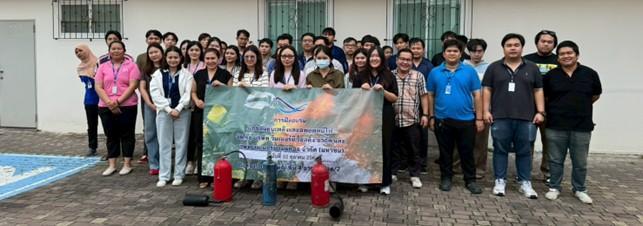
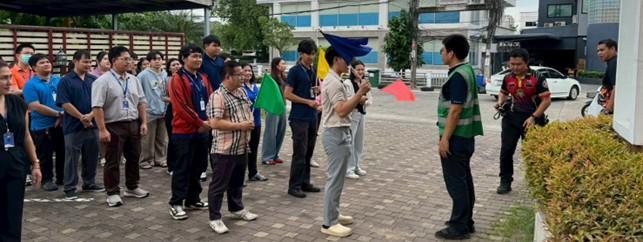
The Company has organized annual fire safety and evacuation training for employees from all departments. The objective of the training is to review knowledge on fire prevention, emergency situation assessment, and proper compliance with evacuation procedures in accordance with legally required safety standards.

The training program includes both theoretical and practical sessions, covering topics such as basic fire prevention and suppression principles, proper use of fire extinguishers, emergency reporting and communication procedures, systematic and safe building evacuation processes, and basic assistance for affected individuals.

Employees also participate in Fire Drill Simulations to familiarize themselves with evacuation routes, assembly points, and their respective roles and responsibilities during emergency situations. This helps build confidence and reduce panic in the event of an actual emergency. The Company promotes a prevention-oriented organizational culture, ensuring that employees can work in a safe environment, maintain good well-being, and perform their duties with confidence.

Other guidelines related to business code of conductPolicy on Holding Directorships and Executive Positions at Other Companies by the Chief Executive Officer (CEO)

The Chief Executive Officer (CEO), or any person authorized by the CEO, who intends to hold a position as a director, senior executive, or any other role in a company or legal entity that is not a subsidiary or an associate of the company, and which is not part of the company’s group operations, must notify the Board of Directors for acknowledgment and to assess the appropriateness before assuming the position. The CEO must also disclose the number of positions currently held. The CEO may serve as a director in no more than one-fifth (1/5) of such external companies.

Furthermore, in order to ensure that the company benefits fully from the CEO’s time and that the CEO can effectively dedicate themselves to their role as the company’s top executive, the policy prohibits the CEO from holding positions as chairman, CEO, or any other role with similar responsibilities in companies that are not subsidiaries or associates of the company.

Promoting Compliance with the Code of Conduct

Promotes Compliance by Directors, Executives and Employees

Yes

Description

The Company requires that all directors, executives, and employees at all levels and new employees are aware of and understand the company’s code of conduct for conducting business and must sign a report certifying that they will abide by the code of conduct. The Company has published its “Code of Business Conduct” on the Company’s website

Anti-Corruption Networks & Projects

Joined or Declared Intent to Join Anti-Corruption Networks

No

Networks & Projects Joined

Network / Project
Thai Private Sector Collective Action Against Corruption: CAC
United Nations Global Compact (UNGC)
Participation of anti-Corruption networks and initiatives

Material Changes & Developments in CG

Reviewed the CG Policy or Board Charter in the Past Year

Yes

Material Changes or Developments in the Past Year

No

Policy Review — Description

The Board of Directors places great importance on compliance with applicable laws and the principles of good corporate governance. The Board believes that conducting business in accordance with good corporate governance practices will create long-term value for the Company and enhance confidence among investors and stakeholders. Therefore, in 2025, the Company implemented several important developments and improvements in this regard, including the following:

  1. Review of the Corporate Governance Policy to ensure alignment with the principles of good corporate governance. The review covers key areas, including:

    • Roles, duties, and authority of the Board of Directors

    • Qualifications of directors

    • Nomination and appointment process for directors

    • Board of Directors’ meetings

    • Performance evaluation of the Board of Directors

    • Compliance with laws and business ethics

    • Review of the Code of Conduct and various corporate policies, including internal regulations and guidelines such as the Investment Policy, Anti-Corruption Policy, Related Party Transaction Policy, Risk Management Policy, Whistleblowing and Complaints Procedure, Accounting Policy, and Information Technology Policy, to ensure alignment with good corporate governance principles, best practices, and the Company’s operational practices.

    • Establishment of criteria for shareholders to propose agenda items for the Annual General Meeting of Shareholders and to nominate qualified persons for consideration as candidates for election as directors.

    • Employee training on the Code of Conduct, organized by the Human Resources Department as part of the Company’s new employee orientation program.
      Encouragement for directors, executives, and employees to participate in training programs related to good corporate governance and sustainable business practices.

Implements the CG Code for Listed Companies

No

CG Code — Description

The Company conducts its business in accordance with the Corporate Governance Code (CG Code) for listed companies issued by the Securities and Exchange Commission. The Board of Directors performs its duties with responsibility and integrity, establishes clear objectives and strategies aimed at sustainable value creation, and ensures appropriate risk management and internal control systems. The Company also promotes ethical conduct and transparency in its operations, along with timely, accurate, and fair disclosure of information, to safeguard the best interests of shareholders and all stakeholders.

Other CG Performance & Outcomes

The Board of Directors places great importance on corporate governance and sustainable business development. The Board also encourages employees at all levels to apply these principles in their daily operations in a concrete and practical manner. As a result of these efforts, the Company has achieved the following recognitions:

  • The Annual General Meeting (AGM) Quality Assessment 2025
    The Company received a 5-Coin rating (full score of 100 points) for the third consecutive year.

  • Corporate Governance Report of Thai Listed Companies (CGR) 2025 The Company was rated “Excellent” (5 Stars) for the third consecutive year.
Contents