

MD&A · 2025
In this section3 topics
Overview of Operations
Overview of Operations
The Company and its subsidiaries (“the Company”) operate a business importing and distributing medical devices, medical equipment, and diagnostic test kits used for collection, analysis, diagnosis, and medical treatment. These products are sourced from leading manufacturers overseas. In addition, the Company operates a medical technology clinic and laboratory (Winmed Clinic and Laboratory), as well as providing genetic diagnostic services. Its customer base includes hospitals, medical institutions, government agencies, and healthcare professionals nationwide.
In 2025, the Company continued to focus on expanding its core product segments alongside ongoing public health promotion initiatives. The Company expanded collaborations with Provincial Administrative Organizations, hospitals, and local public health agencies to implement disease screening programs and improve access to medical services for the public. Furthermore, the Company continued to source and import new medical products from leading international manufacturers to enhance its competitiveness and support the growing demand of Thailand’s healthcare system.
However, in 2025, the Company was affected by certain external factors, particularly the Provincial Administrative Organization elections and political changes during late 2024 through early 2025. These factors caused delays in the approval process of public health projects in several areas, resulting in some cervical cancer screening activities not being carried out as planned. Nevertheless, the Company adjusted its operational plans by expanding mobile health screening caravan projects and increasing collaboration with public health agencies in other areas to maintain continuous access to services for the public.
In addition, new contracts entered into by the Company involved changes in contract structure and payment terms. Previously, contracts were structured as “open-ended reagent purchase agreements,” under which revenue was recognized upon product delivery. These have been changed to “medical equipment rental agreements,” with monthly payment terms based on the actual volume of completed test reports. As a result, the Company’s revenue recognition model has changed accordingly.
The Company has also revised its revenue recognition method to comply with Financial Reporting Standard No. 15 (Revenue from Contracts with Customers), in accordance with auditors’ recommendations. This ensures that revenue recognition appropriately reflects the nature of transactions and contractual terms, and complies with generally accepted accounting principles.
Such impacts arose from changes in contract structure and adjustments to revenue recognition in 2025. These are considered one-off effects related to accounting adjustments and the transition period of contracts and may affect the comparability of operating results with the previous year.
Analysis of Operating Results for 2025
Revenue
In 2023–2025, the Company recorded total revenues of THB 639.18 million, THB 654.36 million, and THB 647.04 million, respectively. The Company’s revenue consists of sales and service income, as well as rental income, with details as follows:

The Company generated rental income from providing equipment sets used together with diagnostic test kits, including installation and readiness for use, in accordance with the requirements of its contractual counterparties. Therefore, in compliance with Thai Financial Reporting Standard No. 15 (TFRS 15), the Company separates revenue from product sales from revenue related to equipment installation for operational readiness (i.e., separating sales revenue and rental income) to clearly reflect the consideration received from the transfer of goods or services. Rental income is calculated using a cost-plus pricing method, whereby the cost of rental income includes depreciation and maintenance expenses of diagnostic equipment.
Total operating revenue in 2025 was supported by growth in the Cell & Molecular Technology product group. The Company delivered the CliniMACS Prodigy system to government agencies for the treatment of thalassemia patients using gene therapy technology, an advanced treatment innovation that plays a significant role in the development of the country’s healthcare system. This also reflects the Company’s capability to introduce advanced medical technologies to support treatment in Thailand.
In addition, the Medical Blood Procurement products and services segment, as well as the Blood Safety product segment, continued to grow. The Company delivered automatic blood bag weighing and mixing devices to the National Blood Centre, Thai Red Cross Society, after winning the procurement bid for this project. Furthermore, strengthening the sales team enhanced the Company’s ability to reach customers and create new business opportunities, resulting in increased success in bidding and expansion of projects with medical institutions.
For the Reproductive Health product group, although it was affected by delays in cervical cancer screening activities in certain areas due to provincial administrative organization elections nationwide during late 2024 through early 2025, the Company adjusted its operational plans and expanded collaboration with public health agencies in other areas. This helped maintain service levels and partially mitigate the impact on revenue from this segment.
Meanwhile, the Consumer business segment, which includes mosquito and blood-sucking insect trapping products operated by A New Day Co., Ltd., a subsidiary, recorded an increase in revenue of THB 4.86 million. This growth was driven by effective marketing strategies through online channels and social media, which improved product awareness and continuously stimulated sales.
Cost of Goods Sold and Gross Profit Margin
In 2023–2025, the Company reported total costs of THB 380.75 million, THB 387.69 million, and THB 370.72 million, respectively. These represented cost-to-revenue ratios of 59.57%, 59.25%, and 57.30%, respectively. As a result, the Company recorded gross profits of THB 258.43 million, THB 266.66 million, and THB 276.31 million. This improvement was driven by better product mix management, more efficient cost control, and price adjustments for certain products. However, for sales under purchase agreements with predetermined pricing conditions, the Company is unable to increase prices until the contracts expire.
Distribution Costs and Administrative Expenses
The Company’s total distribution costs and administrative expenses for 2023–2025 were THB 224.34 million, THB 242.19 million, and THB 267.91 million, respectively. The increase in these expenses was mainly due to the expansion of sales and marketing personnel, higher travel and operational expenses related to business partnerships, sourcing of new products from overseas, and costs associated with new business development. These expenses align with the Company’s long-term business expansion and strategic investment plans. Although the Company improved its gross profit margin through better cost management, these expenditures represent investments to support long-term growth. While the increase in expenses resulted in a decline in operating profit in 2025, the Company expects these investments to drive future revenue growth.
Finance Costs
The Company’s finance costs for 2023–2025 were THB 9.07 million, THB 12.17 million, and THB 15.91 million, respectively. The increase in finance costs was primarily due to the utilization of credit facilities to support working capital for importing products, as well as higher interest rates on long-term borrowings compared to the previous year, resulting in a higher interest burden for the Company.
Net Profit for the Period
The Company reported net profits of THB 30.64 million, THB 29.26 million, and THB 15.17 million for the years 2023–2025, respectively. This was a result of changes in revenue, cost of goods sold, distribution costs, and administrative expenses as described above.
Financial Position Overview
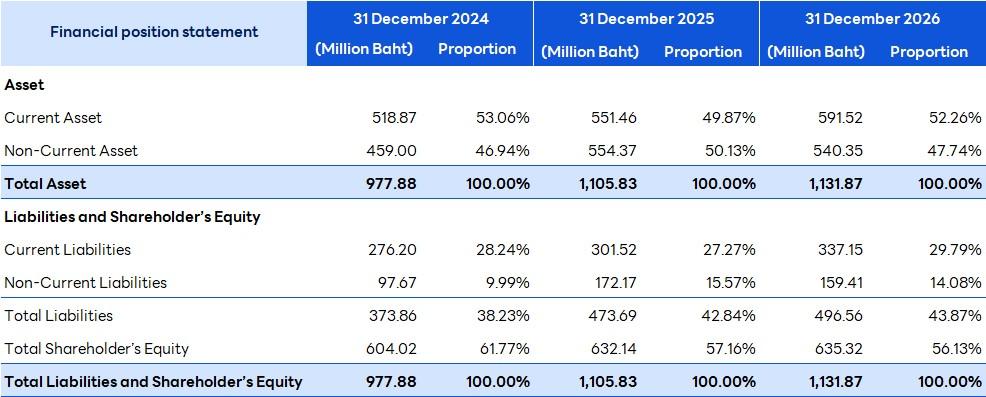
Overview of the Company’s Financial Position
As of December 31, 2023–2025, the Company reported total assets of THB 977.88 million, THB 1,105.83 million, and THB 1,131.87 million, respectively. In 2025, total assets increased by THB 26.04 million, or 2.35% from the previous year, reflecting the Company’s continued business expansion, particularly in working capital used to support sales and project delivery under contractual agreements.
Assets
As of December 31, 2025, the Company had current assets of THB 591.52 million, an increase of THB 40.06 million, or 7.27% from the previous year. This increase was mainly due to higher trade receivables and other current receivables in line with the revenue recognition cycle, increased inventory to support product distribution, and prepaid expenses for goods in preparation for contract fulfillment. This reflects effective working capital management to support business operations.
At the same time, non-current assets as of December 31, 2025 totaled THB 540.35 million, a decrease of THB 14.02 million, or 2.53% from the previous year. The decline was primarily due to depreciation of fixed assets and amortization of intangible assets over their useful lives. The Company continues to manage investments in non-current assets prudently in alignment with its business plan and long-term investment efficiency.
Liabilities
As of December 31, 2025, the Company had total liabilities of THB 496.56 million, an increase of THB 22.87 million, or 4.83% from the previous year. This increase was mainly driven by higher current liabilities, particularly short-term borrowings from financial institutions and obligations related to working capital management to support product procurement and business operations. Meanwhile, non-current liabilities decreased due to scheduled repayments of long-term loans.
Shareholders’ Equity
As of December 31, 2025, the Company’s shareholders’ equity amounted to THB 635.32 million, an increase of THB 3.18 million, or 0.50% from the previous year. This was mainly attributable to net profit for the year, offset by dividend payments in accordance with the resolution of the 2025 Annual General Meeting of Shareholders. As a result, the Company’s capital base remains sufficient to support its operations, although the growth rate of equity this year was relatively modest compared to the previous year.
Overview of Capital Structure
Overall, in 2025, the Company maintained a well-balanced financial structure. The increase in assets was primarily in current assets to support business operations, while the rise in liabilities was aligned with working capital management and product procurement. The Company continues to prioritize liquidity management, monitoring receivables collection, controlling inventory levels, and managing debt obligations at an appropriate level.
Sustainable Development Operations
The Company conducts its business based on the principles of sustainable development, alongside balanced business growth and responsibility toward society and the environment. It places importance on good corporate governance (Environmental, Social, and Governance: ESG) to create long-term value for all stakeholders.
The Company has established a sustainability governance structure, with the Corporate Governance and Sustainable Development Committee responsible for setting policies, overseeing, and driving ESG initiatives to ensure transparent, responsible business operations in line with best practices for listed companies.
In 2025, the Company received a 5-star (Excellent) rating in the Corporate Governance Report of Thai Listed Companies (CGR) for the third consecutive year from the Thai Institute of Directors Association (Thai IOD). It also achieved a full score of 100 points (5 medals) in the AGM Checklist assessment from the Thai Investors Association. These recognitions reflect the Company’s commitment to transparency, good governance, and the protection of shareholders’ and stakeholders’ rights.
In 2025, the Company made progress in ESG performance across the following areas:
Environmental (E)
The Company places importance on efficient resource utilization and minimizing environmental impact. It has implemented initiatives to reduce electricity and water consumption within offices and warehouses, along with regular inspection and maintenance of utility systems to ensure operational efficiency.
In addition, the Company has implemented an internal waste separation program to promote proper waste management, reduce landfill waste, and support the concept of a circular economy. The Company also organized the “Happiness Box” initiative, encouraging employees to donate unused items such as clothing, bags, shoes, cosmetics, and other personal belongings to be redistributed to organizations or individuals in need. This initiative helps reduce waste and promotes efficient resource utilization.
Social (S)
The Company recognizes its role in supporting the public healthcare system and improving the quality of life for the population, particularly as Thailand continues to face challenges related to shortages of blood and platelets for patient treatment. The Company has therefore implemented blood and platelet donation programs, both on-site and off-site, to increase public access to blood donation and help ensure sufficient blood supply within the healthcare system.
Furthermore, the Company has carried out mobile health check-up caravan projects in collaboration with government agencies and local administrative organizations in various areas, such as Rangsit Municipality, Nakhon Sawan Provincial Administrative Organization, and Nakhon Ratchasima Provincial Administrative Organization. These initiatives aim to improve access to basic healthcare services, reduce health risks through early detection, and enhance overall quality of life. The programs also help raise health awareness and encourage community participation in sustainable healthcare practices.
Governance (G)
The Company emphasizes good corporate governance by establishing clear corporate governance policies and practices to ensure transparent, accountable, and auditable business operations, while appropriately considering the interests of shareholders, investors, and all stakeholders. The Company also discloses key information through its website to ensure transparent and equitable access to information.
In addition, the Company has established a whistleblowing channel for employees and stakeholders to report misconduct, legal violations, breaches of regulations, company policies, or business ethics. The Company ensures confidentiality and proper protection of whistleblowers, along with structured processes for reviewing and following up on reported cases, in support of good governance practices.
In 2025, the Company also promoted ESG knowledge development among its personnel by encouraging employees to participate in the “ESG DNA” e-Learning program organized by the Stock Exchange of Thailand. This initiative aims to enhance understanding of ESG principles and support their practical application across different functions. A total of 210 employees participated in the program, with more than 70% successfully completing all four required courses, reflecting the Company’s commitment to human capital development and aligning operations across all departments with its sustainable development goals.
Debt Securities with Financial Ratio Requirements
Debt Securities with Financial Ratio Requirements Issued?
No
Factors That May Affect Financial Condition
Factors or Incidents That May Materially Affect Financial Condition
Factors Affecting Future Business Operations
The Company continuously monitors and assesses various factors that may affect its business operations to plan and manage potential risks effectively. Key factors that may impact the Company’s future operations include the following:
1. Economic Conditions
Changes in domestic and global economic conditions, such as inflation, interest rates, and foreign exchange rates, may affect the Company’s operating costs. In particular, many medical devices and equipment must be imported from overseas, which may lead to fluctuations in product prices and may affect the Company’s profitability.
2. Government Policies and Related Regulations
The Company’s business operations are closely related to public healthcare policies and government budgets, such as those of the National Health Security Office (NHSO) and Provincial Administrative Organizations (PAOs). In addition, regulations relating to the registration and control of medical devices may affect the Company’s operations. Any changes to these policies or regulations may affect project implementation, procurement processes, or demand for the Company’s products and services.
3. Medical Technology and Innovation
The medical device industry is rapidly evolving, particularly in areas such as artificial intelligence in diagnostics (AI Diagnostics), cell and gene therapy technologies, and precision medicine. These developments may create both new business opportunities and competitive challenges. If the Company is unable to adapt to or develop technologies in line with industry trends promptly, it may affect its competitiveness.
4. Industry Competition
Competition in the medical device industry continues to intensify, both from domestic and international companies. This is particularly evident in government (B2G), private (B2B), and consumer (B2C) markets. Such competition may lead to price pressures, the introduction of new technologies, and the expansion of distribution channels. Therefore, the Company must continuously strengthen its competitive capabilities in terms of product quality, service excellence, and customer relationships.
5. Human Resources
The medical device industry requires highly skilled professionals with specialized expertise in medical science, biomedical engineering, and biotechnology. A shortage of skilled personnel may affect the Company’s ability to expand its business. Therefore, the Company places strong emphasis on personnel development, fostering a learning-oriented organizational culture, and retaining talented employees for long-term growth.
6. Sustainability and Environmental Considerations
Businesses today are increasingly required to operate in accordance with sustainable development principles, particularly Environmental, Social, and Governance (ESG) practices. This includes efficient resource management and responsible waste management. The Company therefore emphasizes environmentally responsible operations, efficient resource utilization, and continuous improvement of operational processes to align with environmental standards and support sustainable long-term growth.
7. Stakeholders
Maintaining strong relationships and transparent communication with stakeholders, including shareholders, government agencies, customers, business partners, and communities, is essential to building trust and enhancing the Company’s reputation. The Company therefore prioritizes accurate and transparent disclosure of information, stakeholder engagement, and initiatives that create shared value with society to support stable and sustainable growth.
8. Geopolitical Conflicts and International Wars
Geopolitical tensions and international conflicts in certain regions may affect the global economy, supply chains, and international transportation costs. This is particularly relevant for medical devices and equipment that must be imported from overseas, which may be affected by fluctuations in energy prices, transportation costs, and shipping times.
In addition, geopolitical uncertainties may affect foreign exchange rates and the cost of imported goods. Nevertheless, the Company closely monitors these situations. It has implemented supply chain risk management strategies, including diversifying sourcing channels, to ensure business continuity and mitigate potential long-term impacts.